

2026 National Scheme of Delegation: Implications for Planning Decisions from 31st October 2026
At a glance
From 31st October 2026, the National Scheme of Delegation (NSD) will establish a statutory framework for deciding which planning application must be determined by officers i.e. be delegated and which applications can be referred to planning committee. The aim is to provide greater clarity and consistency about the role of committees, allowing them to focus on proposals of genuine significance to the local area.
For applicants, the key change is that local practices such as automatic committee referral following a set number of objections or a ward councillor call-in will no longer be possible. Public consultation and representations will continue, but they will not, of themselves, determine whether an application goes to committee.
How does the NSD operate?
The key distinction in how the NSD will operate is between Schedule 1 and Schedule 2 applications:
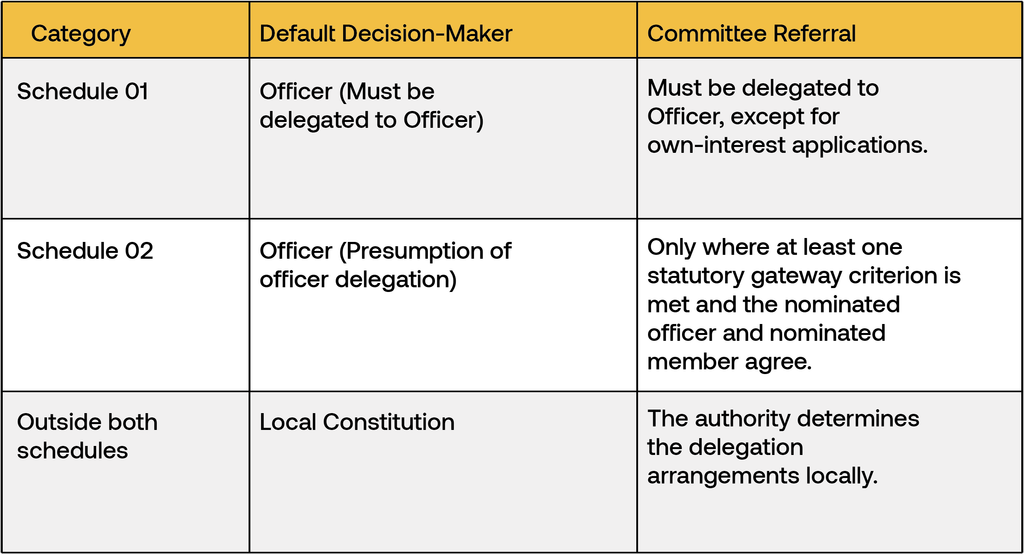
Schedule 1 applications must be delegated to officers, unless it is an own interest application. They include householder and minor commercial development; minor residential development (generally up to nine dwellings on a site of less than 0.5 hectares, development of a block of flats subject to the regulatory definition and other incidental development); discharge of conditions; prior approvals; permission in principle; S96A (non-material) applications; certificates of lawfulness; biodiversity gain plans; certificates of appropriate alternative development; relevant section 106 functions; and certain section 73 and certain reserved matters applications.
Schedule 2 applications includes most other planning applications including applications which are not householder, minor commercial or minor residential, section 73 applications where the previous permission was a Schedule 2 permission, section 73A applications, reserved matters for large outline permissions (involving at least 500 dwellings or a building or buildings with 50,000 sqm or more of floorspace), relevant section 106 functions related to Schedule 2 permissions, listed building consents including discharge/variation of conditions, advertisement consents, and tree preservation order consents.
When can an application go to committee?
Schedule 2 does not automatically mean an application is a committee determination. Officer determination remains the presumption. Referral can only occur where at least one of the following criteria is met and the nominated officer (likely to be the chief planning officer/or their substitute) and nominated member (likely to be the chair of planning committee or their substitute) agree:
- the application raises an economic, social or environmental issue of significance to the local area; or
- the application raises a significant planning matter having regard to the development plan and other material considerations.
Where the nominated officer and member do not agree, the decision remains a delegated one. The guidance states that referral should be exceptional. For the purposes of criterion B, the guidance states that the following are unlikely to raise a significant planning matter:
- Where an application broadly complies with a detailed site allocation and relevant policies
- Where a statutory consultee concern has been resolved through amendments to the proposal
Where an authority has more than one planning committee, more than one nominated officer and nominated member can be nominated.
What does this mean for clients?
The principal benefit should be greater certainty over the decision-making route, particularly for schemes that might previously have reached committee because of objection thresholds or councillor call-ins. Schedule 2 will remain relevant, however, for most major applications and other locally significant schemes.
For policy-compliant development, the emphasis shifts towards building a strong officer-level case. Policy, design and technical issues should be resolved as early as possible so that the application, consultation responses and supporting evidence present a coherent and defensible case at determination.
For large, phased or strategic schemes, the NSD should be considered at outline stage. Reserved matters relating to large outline permissions are within Schedule 2, so individual phases may still be referred where the gateway is met. For renewable energy, infrastructure and other complex proposals, significant landscape, heritage, environmental or local issues may likewise engage the gateway.
Community and stakeholder engagement remains important, but its role changes: it will be less about creating a route to committee and more about understanding, addressing and evidencing how local issues have been dealt with.
Local Implementation and live applications
The NSD substantive categories are nationally prescribed, but authorities will still differ in how they operate the referral process. They may decide which Schedule 2 cases need to be considered for referral and may use triage arrangements. Authorities will need to amend their constitutions, removing incompatible call-in and objection triggers, identify nominated officers and members, and comply with the maximum committee size of 13 members. The guidance warns that non-compliance may expose an improperly determined committee decision to judicial review and possible quashing.
The Regulations come into force on 31 October 2026. For applications approaching determination around that date, applicants should confirm the likely Schedule 1 or Schedule 2 classification and the authority’s revised arrangements. Consideration should be given as to whether to seek determination under the existing or new procedures.
Recommended Approach
tor&co recommend the following approach to all clients preparing applications for determination:
- establish the likely NSD classification at the outset;
- understand the authority’s revised constitution and referral process;
- for Schedule 2 proposals, consider whether either gateway criterion could realistically apply;
- use pre-application and post-submission engagement to resolve policy, design and technical issues early; and
- for major or phased schemes, consider the decision-making route for future reserved matters as part of the outline strategy.
The practical shift is moving from relying on committee consideration at the point of decision to building a robust, well-evidenced planning case from the outset. This reinforces the value of an integrated planning, technical, environmental, design and stakeholder strategy.
Sources
Ministry of Housing, Communities and Local Government, Planning Committees and the National Scheme of Delegation of Planning Functions: Guidance for local planning authorities in England (1 June 2026).
Town and Country Planning (Discharge of Local Planning Authority Functions) (England) Regulations 2026 (SI 2026/854).
*This note is provided for general information only and does not constitute planning or legal advice. tor&co accepts no liability for actions taken in reliance on it.
Author: Finn Blundell
Senior Planner.